





Most people who move to Austin come for the tech jobs, the tacos, or the live music. Then they walk into a downtown gallery on a Saturday afternoon and end up buying a painting. That’s not an accident. It’s the logical result of a city that has built real cultural infrastructure while most of the national conversation was still focused on New York and Los Angeles.
The collecting scene here is not emerging anymore. It has emerged. And if you’ve been sleeping on it, this piece is your catch-up.
A City That Outgrew Its Own Reputation
Austin crossed one million residents in 2025, making it the twelfth most populous city in the country, according to the U.S. Census Bureau data published by the City of Austin. That number matters for the arts more than most people realize. Gallery markets thrive when a city reaches a critical mass of educated, high-income transplants who have disposable income and no established collecting habit. Austin has all three right now, in abundance.
Tech founders, product managers, and remote executives who relocated from the Bay Area or New York brought their taste with them. But they didn’t bring their existing gallery relationships. That means local galleries are dealing with buyers who are primed to collect but haven’t committed to a program anywhere yet. It’s an open field, and the best Austin galleries are moving quickly to fill it.
The broader cultural sector has also grown up fast. Contemporary art institutions, public murals, and festival programming have multiplied since 2018. None of that happened in a vacuum. It was driven by the same population surge that gave Austin its first NBA franchise, its expanding restaurant scene, and its genuinely competitive real estate market. Culture follows density. Austin has the density now.
The Economics Behind Gallery Culture
Art collecting can feel like a hobby, but it sits inside a very large industry. The Bureau of Economic Analysis reported in 2025 that arts and cultural economic activity reached $1.17 trillion, representing 4.2 percent of U.S. GDP in 2023. That figure grew faster than the broader economy two years running. Fine art galleries are one small slice of that number, but they punch above their weight in terms of cultural signaling: when galleries thrive in a city, buyers, tourism, and media attention follow.
Austin’s gallery operators have noticed this. The programming has gotten sharper, the artist rosters more internationally recognized, and the exhibition calendar more thoughtfully planned. This is not a scene still figuring itself out. The curators here know exactly what they’re doing.
“Collectors who discover a market early build the strongest collections. Regional cities with institutional-quality programming tend to produce exactly that window.”
This reflects a widely documented pattern observed by art advisors and auction house specialists tracking secondary-market growth in regional U.S. cities over the past decade.
What Serious Galleries Actually Look Like in Austin
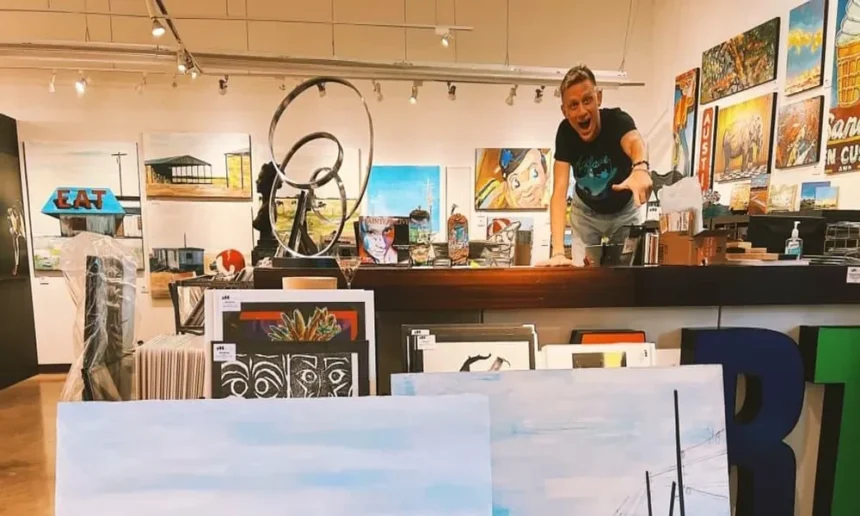
Here’s a concrete scenario. You book a Saturday afternoon visit, no pressure, no prior appointment required. You walk into a gallery showing a solo exhibition by a mid-career street artist with work in private collections across Europe. The front desk tells you prices, explains the artist’s process, and offers to pull out works not on the floor. You spend 45 minutes looking. By the time you leave, you’ve already started imagining where one particular piece would sit in your entryway.
That experience, relaxed but curatorially rigorous, is exactly what the best Austin spaces are offering right now. The art exhibitions in Austin, TX, at West Chelsea Contemporary are a strong example: museum-caliber contemporary shows in a downtown setting that draws both serious collectors and first-time buyers, with free admission and a walk-in-friendly format that removes the intimidation factor most people associate with high-end galleries.
No velvet ropes. No implicit dress code. Just good work, accessible programming, and staff who know the artists personally.
The Collector’s Entry Point Framework
New collectors in Austin often overcomplicate their first purchase. Here’s a simpler way to think about where to start, based on how experienced buyers actually build their first ten acquisitions.
| Stage | What to Do | Why It Works |
|---|---|---|
| 1. Visit without intent to buy | Attend 4 to 6 exhibitions across different galleries | You calibrate your eye before your wallet gets involved |
| 2. Buy something small first | A works-on-paper piece or a limited edition print | Low financial risk, high educational value about your own taste |
| 3. Ask about the artist’s trajectory | Ask the gallerist where this artist was five years ago | Reveals curatorial confidence and contextualizes pricing |
| 4. Build a relationship, not a transaction | Return to the same gallery multiple times | Gallerists offer better access to waitlisted work for known buyers |
| 5. Buy what you’d keep on your wall for 20 years | Ignore investment framing entirely | Taste-driven collections age better than speculation-driven ones |
Step three is the one most newcomers skip, and it’s the most revealing. A gallerist who can answer that question fluently, with specific details about shows, placements, and institutional recognition, is one worth trusting with your budget.
Austin vs. the Established Markets: An Honest Comparison
New York and Los Angeles are not competition for Austin. They’re a different product entirely. The blue-chip secondary market, the auction house previews, the blue-chip dealer relationships that take years to build: all of that sits in those two cities. Austin cannot replicate it, and shouldn’t try.
What Austin offers instead is access. You can walk into a gallery showing work by an internationally recognized contemporary artist, speak directly with the person who placed that artist’s work in major collections, and buy something meaningful without needing a referral or a pre-existing relationship. That access is genuinely rare. In New York, it costs social capital. In Austin, you just walk in.
For a collector building from scratch, that matters enormously. You’re not operating at a disadvantage. You’re operating in a market where the barriers are lower and the curatorial quality has already caught up.
How to Make Your First Gallery Visit Count
- Go during a opening reception if one is listed. The artist is often present, and the conversation you have in that room is worth more than an hour of online research.
- Come with a rough budget range in mind, not a firm number. Flexibility lets you respond to what actually moves you rather than what you came in expecting to buy.
- Ask specifically about the artist’s exhibition history, not just their biography. Shows tell you more than bio statements do.
- Don’t write off a piece because you don’t know the artist’s name. Austin galleries are surfacing talent before national recognition catches up. That’s precisely where the interesting collecting happens.
The galleries worth your time will answer every question you have without making you feel like you’re taking a test. That’s the baseline expectation. Anything less and you move on.
The Quiet Shift That’s Already Happened
Austin’s art scene stopped being a punchline about live music and weird bumper stickers somewhere around 2020. What replaced it is a city that takes contemporary art seriously, programs it consistently, and has the collector base to sustain it. The infrastructure is real. The programming is real. The only thing still catching up is the national narrative.
If you’re in Austin and you haven’t walked into a gallery yet, book the time this weekend. The scene is not waiting for you to be ready. It’s already moving.